
10/15/2026
Photo Courtesy of the Roberto Cavalli Instagram
Men are unreliable.
They change their minds. They get scared. They need space. They tell you they aren't ready for a relationship, then appear six weeks later in someone else's Instagram carousel. They make you feel insane for asking questions that would have been answered in approximately four seconds by a person with any intention of keeping you around.
Roberto Cavalli, on the other hand, has spent the better part of five decades giving women animal print, plunging necklines, sheer fabric, and an unreasonable amount of confidence. He has never asked us to be less intimidating. He has never suggested we tone it down. He has never made us feel like we were asking for too much.
At least someone knows what he wants.
And while I can't promise that a man wearing Roberto Cavalli is any more emotionally available than one wearing anything else, I can tell you that the brand itself has remained remarkably committed to its identity. In a world where everyone seems to be reinventing themselves, Cavalli has always known that the leopard never needed an apology.
Roberto Cavalli has never had an identity crisis. And if he did, he certainly wouldn't dress like it.
A leopard doesn't change its spots
Roberto Cavalli's story begins in Florence, Italy, where the designer was born in 1940 into a family with an artistic background. His grandfather was a painter, and Cavalli studied at the Florence Art Institute before experimenting with textile printing. By the early 1970s, he had established his namesake fashion house, developing innovative printing techniques and experimenting with leather, patchwork, and denim.
His clothes were never particularly interested in behaving themselves.
Animal prints became the signature. Silk shirts were embellished, embellished again, and then probably given a little more cleavage for good measure. Cavalli understood that a woman could be elegant and excessive, glamorous and a little dangerous, all without having to choose between the two.
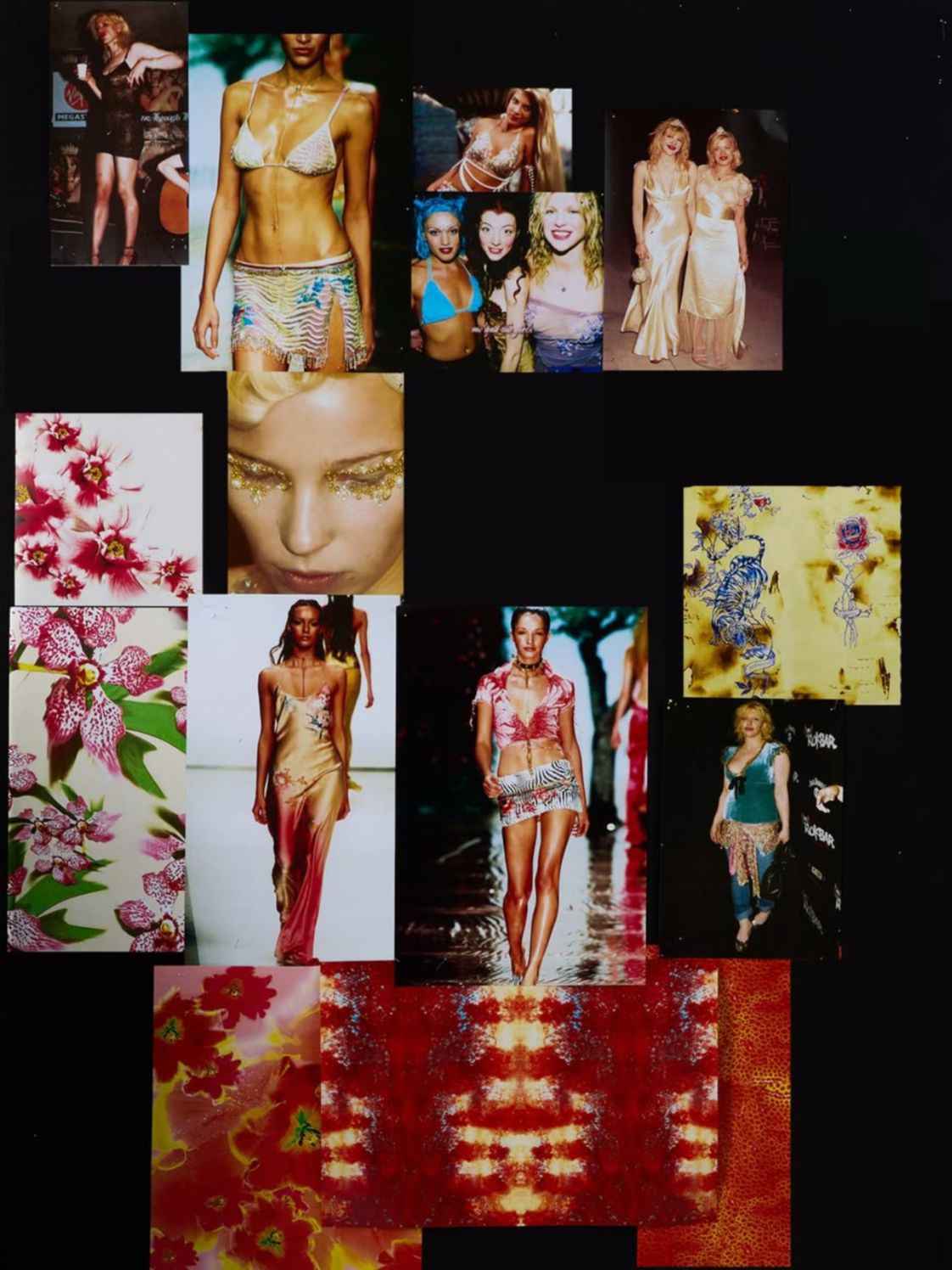
By the 1990s, his animal prints had become internationally recognizable, and the brand entered the cultural consciousness with the kind of sex appeal that doesn't exactly whisper. The Cavalli woman was bronzed, confident, and dressed as though she had somewhere considerably more interesting to be than wherever you were standing.
She was not dressing to blend in. She was not dressing for the male gaze, necessarily, although she was certainly not afraid of it. And she was definitely not dressing to appear as though she hadn't tried.
I have always found something refreshing about a designer who understands that getting dressed can be an exercise in pleasure rather than self-correction.
Somewhere along the way, fashion decided that the highest form of sophistication was looking as though you hadn't cared enough to try. The neutral wardrobe and effortless hair. The face that looks like it has never encountered a stressful situation or an expiration date.
Cavalli never got the memo.
Or perhaps he received it and decided it was boring.
We used to have fun
There was a time when Cavalli was everywhere. The late nineties and early 2000s belonged to a particular kind of glamour, one that didn't mind being obvious about itself. Jennifer Lopez, Christina Aguilera, and the era's other pop-culture fixtures helped cement the brand's association with celebrity, nightlife, and unabashed sex appeal.
It was a world of low-rise jeans, exposed waistbands, metallic fabrics, oversized sunglasses, and dresses that required a certain level of confidence to wear and possibly a certain level of confidence to look at.
And then, naturally, we got embarrassed.
Fashion is an industry with a remarkable capacity for making us feel foolish about the things it told us to want five minutes ago. The same aesthetic that once signified glamour eventually became tacky.
Minimalism took over. Quiet luxury arrived. The clean girl emerged from whatever laboratory manufactures women who apparently have no pores, no problems, and an unlimited supply of matching workout sets.
And Cavalli? Well, Cavalli was still Cavalli.
But I have to wonder whether we were ever really tired of Cavalli, or whether we had simply become uncomfortable with wanting to be seen.
There is a difference between dressing well and dressing to disappear. There is a difference between sophistication and restraint. And there is certainly a difference between having good taste and allowing other people to dictate what you should want.
Enter Fausto Puglisi
When Fausto Puglisi took over as creative director in 2020, he inherited a house with an unmistakable identity and the challenge of making it relevant without sanding off the very things that made it interesting.
It's a difficult balance. Fashion houses are expected to evolve, but too much evolution can leave you wondering whether the original thing you loved is still there at all. We want our favorite brands to surprise us, provided they don't surprise us by becoming something entirely different.
Puglisi seems to understand the assignment.
His interpretation of Cavalli has continued to embrace the house's appetite for sensuality, print, and spectacle. Rather than treating the archive as something to be rescued from its own reputation, he has treated it as something worth revisiting.
And perhaps that's the difference between a designer who understands a brand and one who merely understands trends. Trends can be borrowed. An identity has to be lived in.
Which brings us to September 2026, when Puglisi presented the Spring/Summer 2027 Ready-to-Wear collection, House of Prints.
The title alone feels like a declaration of intent.
Animal stripes collide with florals, python, and other competing patterns. Fabrics overlap and fragment. Denim, chiffon, and stretch silhouettes coexist together.
It is maximalist, sensual, and gloriously uninterested in moderation.
In other words, it is Cavalli.
And that's what makes the collection so satisfying. Puglisi isn't trying to convince us that Cavalli can be something else. He is reminding us why we wanted it in the first place.
Perhaps the most radical thing a fashion house can do is remain recognizable in an industry that rewards reinvention.
Commitment looks good on you
I've been thinking about how much of modern life is built around the possibility of an exit.
We want to be desirable but not predictable. We want to be independent but still chosen. We want to be understood without having to explain ourselves, loved without having to ask for it, and free without ever having to sit through the uncomfortable parts of being known.
Dating can feel like an endless audition in which everyone is trying to appear sufficiently interesting to be chosen and sufficiently unbothered to survive not being chosen.
Meanwhile, Roberto Cavalli has been standing in the corner wearing leopard print for fifty years.
He knows what he likes. He knows what the house stands for. He has watched minimalism come and go, watched his aesthetic become fashionable and unfashionable, and watched the industry eventually circle back to the very things it once considered too much.
Consistency does not mean never changing. It means knowing which parts of yourself you aren't willing to abandon just because the room has changed its mind.
And I think there is something rather attractive about that.
Not the stubbornness of refusing to grow, but the confidence of growing without erasing yourself.
Imagine how much easier dating would be if we all possessed a fraction of that conviction. If we could say what we wanted without pretending we didn't care. If we could like someone without performing indifference. If we could be a little excessive, a little demanding, a little too much, without immediately wondering whether we should make ourselves easier to swallow.
Maybe we would still get our hearts broken. Roberto Cavalli cannot save us from everything.
But at least we might stop mistaking our willingness to shrink for our ability to love.
The leopard stays
Men come and go. Trends come and go. Our tastes change, our priorities shift, and sometimes we wake up one morning and realize that the things we once loved no longer fit.
But some things deserve to be loved without having to prove their usefulness. Some things are worth keeping simply because they make us feel more like ourselves.
And if the fashion industry has taught us anything, it's that what goes out of style has a funny way of coming back.
I suppose I'll keep dating in the meantime.
But I'll be doing it in leopard.